
TWN Info Service on Biosafety
22 December 2025
Third World Network
www.twn.my
Dear Friends and Colleagues
Cornerstone Paper on the Supposed Safety of Glyphosate is Retracted
The journal Regulatory Toxicology and Pharmacology has formally retracted a scientific paper published in 2000 that became a key defence for Monsanto’s claim that its Roundup herbicide and its active ingredient, glyphosate, don’t cause cancer (Item 1). The herbicide is widely used in conjunction with GM herbicide-tolerant crops.
Bayer, which bought Monsanto in 2018, faces thousands of lawsuits from people who claim to have developed cancer after exposure to its glyphosate products. The retraction stems from the US litigation, which in 2017 revealed that the paper was apparently ghostwritten by Monsanto. Nonetheless, it continued to be cited as evidence supporting glyphosate’s safety. This fact was subjected to strong criticism in a peer-reviewed paper published in September 2025 (Item 2) which states that “Corporate ghost-writing is a form of scientific fraud”.
The editor-in-chief of the journal has written a detailed explanation for his decision to retract the paper, citing various ethical concerns involving Monsanto (Item 3). Among other things, he writes, “The apparent contributions of Monsanto employees as cowriters to this article were not explicitly mentioned as such in the acknowledgments section”, “the article’s conclusions regarding the carcinogenicity of glyphosate are solely based on unpublished studies from Monsanto” and “the authors did not include multiple other long-term chronic toxicity and carcinogenicity studies, that were already done at the time of writing their review in 1999”.
With best wishes,
Third World Network
__________________________________________________________________________
Item 1
SCIENCE JOURNAL RETRACTS STUDY ON SAFETY OF MONSANTO’S ROUNDUP: ‘SERIOUS ETHICAL CONCERNS’
Carey Gillam
The Guardian
https://www.theguardian.com/us-news/2025/dec/05/monsanto-roundup-safety-study-retracted
5 December 2025
Paper published in 2000 found glyphosate was not harmful, while internal emails later revealed company’s influence
The journal Regulatory Toxicology and Pharmacology has formally retracted a sweeping scientific paper published in 2000 that became a key defense for Monsanto’s claim that Roundup herbicide and its active ingredient glyphosate don’t cause cancer.
Martin van den Berg, the journal’s editor in chief, said in a note accompanying the retraction that he had taken the step because of “serious ethical concerns regarding the independence and accountability of the authors of this article and the academic integrity of the carcinogenicity studies presented”.
The paper, titled Safety Evaluation and Risk Assessment of the Herbicide Roundup and Its Active Ingredient, Glyphosate, for Humans, concluded that Monsanto’s glyphosate-based weed killers posed no health risks to humans – no cancer risks, no reproductive risks, no adverse effects on development of endocrine systems in people or animals.
Regulators around the world have cited the paper as evidence of the safety of glyphosate herbicides, including the Environmental Protection Agency (EPA) in this assessment.
The listed authors of the paper, Gary Williams, Robert Kroes and Ian Munro, were scientists who did not work for Monsanto, and the study was held up by the company as a defense against conflicting scientific evidence linking Roundup to cancer. The fact that it was authored by scientists from outside the company, from seemingly independent researchers, gave it added validity.
But over the last decade, internal company documents, that came to light in litigation brought by plaintiffs in the US suffering from cancer, revealed Monsanto’s influence on the paper. The documents included an email from a company official discussing the research paper and praising the “hard work” of several Monsanto scientists as part of a strategy Monsanto called “Freedom to Operate” (FTO).
The corporate files showed how company officials celebrated when the paper was published.
In one email following the April 2000 publication of the Williams paper, Lisa Drake, then Monsanto government affairs official, described the toll the work of developing “independent” research papers took on multiple Monsanto employees.
“The publication by independent experts of the most exhaustive and detailed scientific assessment ever written on glyphosate … was due to the perseverance, hard work and dedication of the following group of folks,” Drake wrote. She then listed seven Monsanto employees. The group was applauded for “their hard work over three years of data collection, writing, review and relationship building with the papers’ authors”.
Drake further emphasized why the Williams paper was so significant for Monsanto’s business plans: “This human health publication on Roundup herbicide and its companion publication on ecotox and environmental fate will be undoubtedly be [sic] regarded as ‘the’ reference on Roundup and glyphosate safety,” she wrote in the email dated 25 May 2000.
“Our plan is now to utilize it both in the defense of Roundup and Roundup Ready crops worldwide and in our ability to competitively differentiate ourselves from generics.”
In a separate email, a company executive asked if Roundup logo polo shirts could be given to eight people who worked on the research papers as a “token of appreciation for a job well done”.
Monsanto’s Hugh Grant, who at that time was a senior executive on his way toward being named CEO and chairman, added his own praise, writing in an email: “This is very good work, well done to the team, please keep me in the loop as you build the PR info to go with it.”
In 2015, William Heydens, a Monsanto scientist, suggested that he and colleagues “ghost-write” another scientific paper. Monsanto could pay outside scientists to “edit & sign their names” to the work that he and others would do, Heydens wrote in an email. “Recall that is how we handled Williams Kroes and Munro 2000.”
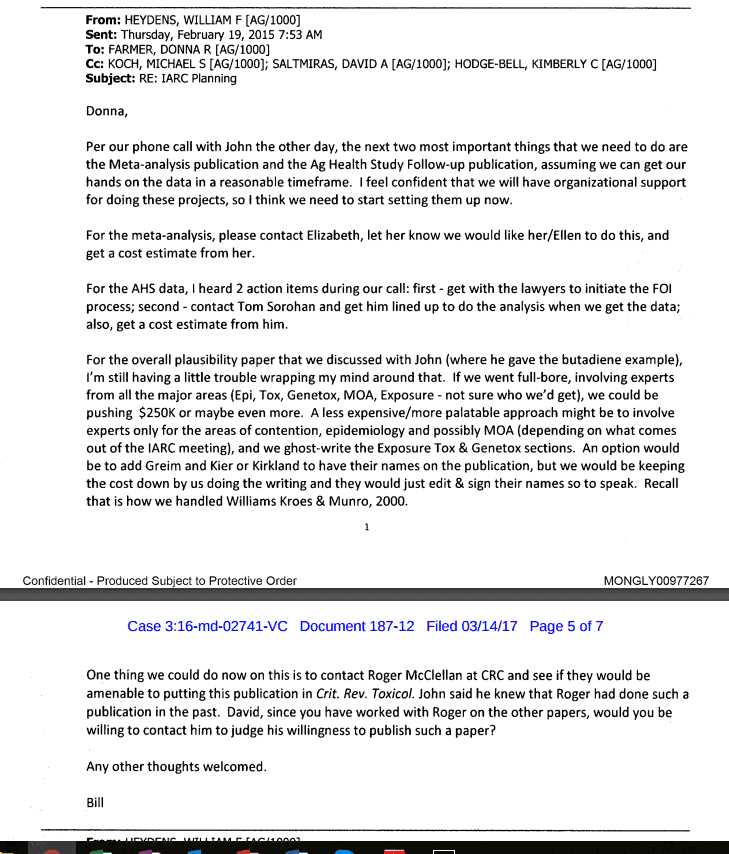
The emails were spotlighted in jury trials in which plaintiffs suffering from cancer won billions of dollars in damages from Monsanto, which was bought by Bayer AG in 2018.
Gary Williams, one of the authors of the now retracted 2000 research paper, could not immediately be reached for comment. In 2017, Williams’s former employer New York Medical School said it found “no evidence” that a faculty member violated the school’s prohibition against authoring a paper ghostwritten by employees of Monsanto. The two other authors of the paper, Robert Kroes and Ian Munro, are deceased.
In explaining the decision to retract the 25-year-old research paper, Van den Berg wrote: “Concerns were raised regarding the authorship of this paper, validity of the research findings in the context of misrepresentation of the contributions by the authors and the study sponsor and potential conflicts of interest of the authors.”
He noted that the paper’s conclusions regarding the carcinogenicity of glyphosate were solely based on unpublished studies from Monsanto, ignoring other outside, published research.
Van den Berg did not respond to a request for comment.
When asked about the retraction, Bayer said in a statement that Monsanto’s involvement was adequately noted in the acknowledgments section of the paper in question, including a statement that referred to “key personnel at Monsanto who provided scientific support”. The company said the vast majority of thousands of published studies on glyphosate had no Monsanto involvement.
“The consensus among regulatory bodies worldwide that have conducted their own independent assessments based on the weight of evidence is that glyphosate can be used safely as directed and is not carcinogenic,” the company said.
An EPA spokesperson said that the agency was aware of the retraction but “has never relied on this specific article in developing any of its regulatory conclusions on glyphosate”.
The spokesperson said the EPA has “extensively studied glyphosate, reviewing more than 6,000 studies across all disciplines, including human and environmental health, in developing its regulatory conclusions”.
The updated human health risk assessment the agency is currently conducting for glyphosate is “using gold standard science”, the spokesman said. That assessment should be released for public comment in 2026 and will not rely on the retracted article.
“The retraction of this study is a long time coming,” said Brent Wisner, one of the lead lawyers in the Roundup litigation and a key player in getting the internal documents revealed to the public.
Wisner said the Williams, Kroes and Munro study was the “quintessential example of how companies like Monsanto could fundamentally undermine the peer-review process through ghostwriting, cherrypicking unpublished studies, and biased interpretations”.
“This garbage ghostwritten study finally got the fate it deserved,” Wisner said. “Hopefully, journals will now be more vigilant in protecting the impartiality of science on which so many people depend.”
News of the retraction of the study came in the same week the Trump administration urged the US supreme court to take up Bayer’s bid to curtail thousands of lawsuits claiming Roundup causes cancer.
In a brief filed at the court, the solicitor general, D John Sauer, said the company was correct that the federal law governing pesticides pre-empts lawsuits that make failure-to-warn claims over the products under state law.
Plaintiffs have said they developed non-Hodgkin’s lymphoma and other forms of cancer due to using Roundup and other glyphosate-based herbicides sold by the company, either at home or on the job.
This story is co-published with the New Lede, a journalism project of the Environmental Working Group.
—————————————————————————————-
Item 2
THE AFTERLIFE OF A GHOST-WRITTEN PAPER: HOW CORPORATE AUTHORSHIP SHAPED TWO DECADES OF GLYPHOSATE SAFETY DISCOURSE
Alexander A. Kaurov and Naomi Oreskes
Elsevier
Environmental Science & Policy, Volume 171, 2025,104160
https://doi.org/10.1016/j.envsci.2025.104160
https://www.sciencedirect.com/science/article/pii/S1462901125001765
September 2025
Abstract
Corporate ghost-writing is a form of scientific fraud: a paper is falsely presented as the work of people other than its actual authors. When such papers circulate, they undermine the integrity of scientific research and policy decisions based wholly or in part on that research. This paper examines the impact of a single ghost-written study, Williams, Kroes, and Munro (2000) (WKM2000), published in Regulatory Toxicology and Pharmacology. The paper was crafted by Monsanto to support claims of the safety of glyphosate, the active ingredient in Roundup. Despite revelations of its ghostwritten nature in the Monsanto Papers, the paper has not been retracted and continues to be cited. Using a case study approach, we trace the impact of WKM2000 across three domains. We find that WKM2000 has exerted considerable influence over two decades, shaping public understanding, scientific discourse, and policy decisions. WKM2000 has been frequently cited on Wikipedia to support the safety of glyphosate; attempts to contextualize its ghostwritten origins have been repeatedly reversed or removed, illustrating how corporate-sponsored science infiltrates public knowledge platforms. An analysis of policy and governance documents citing WKM2000 revealed that the vast majority referenced it uncritically. In academic literature, WKM2000 is in the top 0.1 % by citation count among papers discussing glyphosate, indicating broad uptake, with minimal acknowledgment of conflict of interest. Our findings underscore the need for stricter journal policies to screen and retract ghostwritten papers, in order to safeguard science integrity, as well as public health and safety.
—————————————————————————————
Item 3
RETRACTED: Safety Evaluation and Risk Assessment of the Herbicide Roundup and Its Active Ingredient, Glyphosate, for Humans
Science Direct
https://www.sciencedirect.com/science/article/pii/S0273230099913715?via%3Dihub
Referred to by Retraction notice to “Safety evaluation and risk assessment of the herbicide roundup and its active ingredient, glyphosate, for humans” [Regul. Toxicol. Pharm. 31 (2000) 117–165] Regulatory Toxicology and Pharmacology, Available online 5 December 2025, Pages 106006. Gary M. Williams, Robert Kroes, Ian C. Munro.
Concerns were raised regarding the authorship of this paper, validity of the research findings in the context of misrepresentation of the contributions by the authors and the study sponsor and potential conflicts of interest of the authors. I, the handling (co)Editor-in-Chief of Regulatory Toxicology and Pharmacology, reached out to the sole surviving author Gary M. Williams and sought explanation for the various concerns which have been listed in detail below. We did not receive any response from Prof. Williams.
Hence, this article is formally retracted from the journal. This decision has been made after careful consideration of the COPE guidelines and thorough investigation into the circumstances surrounding the authorship and content of this article and in light of no response having been provided to address the findings. The retraction is based on several critical issues that are considered to undermine the academic integrity of this article and its conclusions:
1) Carcinogenicity and Genotoxicity Assessments The article’s conclusions regarding the carcinogenicity of glyphosate are solely based on unpublished studies from Monsanto, which have failed to demonstrate tumorigenic potential. The handling (co) Editor-in-Chief also became aware that by the time of writing of this article in the journal, the authors did not include multiple other long-term chronic toxicity and carcinogenicity studies, that were already done at the time of writing their review in 1999. In their article the authors state that they are aware of other studies, that were unpublished and not available. However, the authors do not specify to what extent they tried to incorporate the findings of these (unpublished) studies. The reasons for this remain undisclosed but bring into question the broader objectivity of the conclusions presented. The handling (co)Editor-in-Chief identified the following additional publications:
Atkinson C, Martin T, Hudson P, Robb D. Glyphosate: 104 week dietary carcinogenicity study in mice. In: Inveresk Research International. Tranent: IRIProject No. 438618; 1993.
Sugimoto K. 18-Month Oral Oncogenicity Study in Mice, Vol. 1 and 2. Kodaira-shi: The Institute of Environmental Toxicology; 1997. Study No.:IET 94-0151.
Takahashi M. Oral feeding carcinogenicity study in mice with AK-01. Agatsuma: Nippon Experimental Medical Research Institute Co. Ltd.; 1999.
Enemoto K. 24-Month Oral Chronic Toxicity and Oncogenicity Study in Rats, Vol. 1. Kodaira-shi: The Institute of Environmental Toxicology; 1997.
Suresh TP. Combined chronic toxicity and carcinogenicity study with glyphosate technical in Wistar rats. Syngenta: Toxicology Department Rallis Research Centre, Rallis India Limited; 1996.
While it is recognized that these publications were not featured in peer-reviewed journals, the review by Williams, Kroes, and Munro did extensively utilize unpublished studies, which did not seem to impede its publication. Therefore, the conclusions about the non-carcinogenicity of glyphosate or Roundup in this article are limited to the Monsanto studies alone and hamper a general conclusion as suggested by the authors.
2) Lack of Authorial Independence Litigation in the United States revealed correspondence from Monsanto suggesting that the authors of the article were not solely responsible for writing its content. It appears from that correspondence that employees of Monsanto may have contributed to the writing of the article without proper acknowledgment as co-authors. This lack of transparency raises serious ethical concerns regarding the independence and accountability of the authors of this article and the academic integrity of the carcinogenicity studies presented.
3) Misrepresentation of Contributions The apparent contributions of Monsanto employees as co-writers to this article were not explicitly mentioned as such in the acknowledgments section. This omission suggests that the authors may have misrepresented their unique roles and the collaborative nature of the work presented. The failure to disclose the involvement of Monsanto personnel in the writing process compromises the academic independence of the presented findings and conclusions drawn in the article regarding carcinogenicity.
4) Questions of Financial Compensation Further correspondence with Monsanto disclosed during litigation indicates that the authors may have received financial compensation from Monsanto for their work on this article, which was not disclosed as such in this publication. The potential financial compensation raises significant ethical concerns and calls into question the apparent academic objectivity of the authors in this publication, which concerns and questions have not been answered.
5) Ambiguity in Research Findings This article has been widely regarded as a hallmark paper in the discourse surrounding the carcinogenicity of glyphosate and Roundup. However, the lack of clarity regarding which parts of the article were authored by Monsanto employees creates uncertainty about the integrity of the conclusions drawn. Specifically, the article asserts the absence of carcinogenicity associated with glyphosate or its technical formulation, Roundup. It is unclear how much of the conclusions of the authors were influenced by external contributions of Monsanto without proper acknowledgments.
6) Weight-of-Evidence Approach The authors employed a weight-of-evidence approach in their assessment of glyphosate’s carcinogenicity and genotoxicity. While this methodology is sound in principle, the potential biases introduced by undisclosed contributions from Monsanto employees and the exclusion of other existing long-term carcinogenicity studies may have skewed the interpretation of the data. The authors’ critical analysis of both unpublished and published studies must therefore be viewed with caution.
7) Historical Context and Influence The paper had a significant impact on regulatory decision-making regarding glyphosate and Roundup for decades. Given its status as a cornerstone in the assessment of glyphosate’s safety, it is imperative that the integrity of this review article and its conclusions are not compromised. The concerns specified here necessitate this retraction to preserve the scientific integrity of the journal.
8) Conclusion In light of the aforementioned issues, the handling (co) Editor-in-Chief lost confidence in the results and conclusions of this article, and believes that the retraction of this article is necessary to maintain the integrity of the journal. The scientific concerns regarding the lack of carcinogenicity only derived from Monsanto studies, concerns regarding (ghost-) authorship(s) and potential conflicts of interest, none of which have been responded to, are sufficient to warrant this action. We appreciate the understanding of the scientific community regarding this matter and remain committed to upholding the highest standards of integrity in published research in Regulatory Toxicology and Pharmacology.